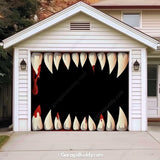
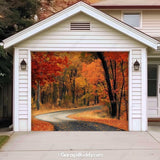
Not every garage looks the same, and that's exactly where a lot of Halloween garage door cover orders go wrong. Some homes have one wide door for two cars. Some have two separate doors side by side. Some have a single door and nothing else. Order based on guesswork instead of your actual layout, and you'll end up with a cover that's too wide, too short, or just doesn't sit right.
The fix is simpler than it sounds: know your layout first, then pick the size that actually matches it. Here's how to get it right the first time.
Quick Answer
To choose the right Halloween garage door cover, first identify your garage layout — single door, one continuous double door, two separate single doors (the "2 Door" option), or a roller door — then measure the actual door panel (not the trim or frame) and match it to GarageBuddy's available sizes. Common size options include 8'x7' and 9'x8' for single doors and 16'x7' and 16'x8' for double doors, with additional sizes available. If your setup doesn't fit a standard layout, check for multi-door options before ordering.
Why Layout Matters More Than Just Size
It's tempting to think choosing a cover is just about width and height, but layout changes what "correct" even means. A 16-foot-wide cover makes perfect sense on one continuous two-car door — but slap it across two separate single doors with a support pillar in between, and it'll never sit flat, no matter how accurate your measuring was. Getting the layout right first is what makes the size numbers actually useful.
Step 1: Identify Your Garage Door Layout

Before you even reach for a tape measure, figure out which of these best describes your garage:
Single Door: One garage door, one car. This is the simplest layout to shop for — measure the one panel and match it to a single-door size.
One Continuous Double Door: A single door spanning a two-car opening, with no pillar or gap in the middle. This is what GarageBuddy lists as a "Double Door" size — measure it as one wide panel.
Two Separate Single Doors (the "2 Door" Option): Two individual doors side by side, usually with a support pillar between them. This setup needs two separate single-door covers rather than one oversized double-door cover, since each door moves independently. GarageBuddy lists this layout as the "2 Door" option.
Three Separate Single Doors: Some homes have three individual garage doors side by side rather than two. GarageBuddy offers options for three-door garages, allowing you to coordinate separate covers across all three doors.
Roller Door: A door that coils upward rather than folding into horizontal panels. These are less common on residential homes but are still compatible with GarageBuddy's current elastic band installation system, as long as there's a suitable point at the bottom to hook both bands to.
Step 2: Measure Based on Your Layout

Once you know your layout, measuring is straightforward:
- Go inside the garage with the door closed.
- Measure the width from the left edge to the right edge of the actual door panel.
- Measure the height from the ground to the top edge of the panel.
- Don't include the trim, frame, or weatherstripping — measure the panel only.
For the two-separate-doors layout, repeat this for each door individually rather than measuring the combined width.
Step 3: Match Your Measurements to a Standard Size
| Garage Layout | Common GarageBuddy Sizes (Width x Height) |
|---|---|
| Single Door | 8' x 7' or 9' x 8' |
| Double Door (one continuous door) | 16' x 7' or 16' x 8' |
Additional sizes are available beyond these — check the size dropdown on the product page for your exact match.
If your measurements land between two sizes, going slightly smaller on width helps the cover stay snug rather than bunched, while a little extra height is easy to work with since the Velcro can be placed higher on the door. A small gap around the edges is normal — GarageBuddy's covers are made slightly smaller than the listed door size on purpose, for a clean fit across doors with varying trim and weatherstripping.
Step 4: Consider Your Design Options by Layout
Layout doesn't just affect fit — it affects which designs make sense. A wide double door gives panoramic scenes more horizontal space, while single doors create a more compact composition. GarageBuddy adapts artwork for different available sizes, so you can choose based primarily on the design you like and the size that fits your door.
GarageBuddy's Halloween garage door cover collection includes everything from classic pumpkins and clowns to full haunted-house scenes, with select designs also available in Glow versions printed with UV-reactive neon inks that light up under blacklight. Browsing by layout first — single or double — narrows things down before you even get to style.
Common Mistakes When Choosing by Layout
- Assuming "double door" always means one continuous panel. Many homes actually have two separate single doors — check for a support pillar before ordering a double-door size.
- Measuring the opening instead of the door panel. The rough opening and the actual door panel aren't always the same size.
- Ignoring roller doors entirely. They're less common, but they're still compatible — don't assume you can't get a cover just because your setup looks different.
- Guessing based on how the garage "feels." A quick tape-measure check takes a few minutes and removes the guesswork entirely.
FAQs
How do I know if I have one double door or two single doors?
Look for a support pillar or visible gap in the middle of your garage. If there's a pillar, you have two separate single doors and should order the "2 Door" option. If it's one uninterrupted panel across the full width, it's a single continuous double door.
Can I use a double-door cover on two separate single doors?
It's not recommended. Two separate doors move independently, so a single continuous cover won't sit or function the way it's designed to. The "2 Door" option is the better match for this layout.
What if I have three separate garage doors?
GarageBuddy offers options for three-door garages, allowing you to coordinate separate covers across all three doors.
Does GarageBuddy make covers for roller doors?
Yes. With the current elastic band installation kit, GarageBuddy covers are compatible with roller garage doors, as long as there's a point at the bottom to hook both elastic bands to.
What if my garage door doesn't match any standard size?
Compare your exact measurements to the available size options first. If you're only off by a few inches, sizing slightly smaller on width or slightly taller on height (by 2-3 inches) usually solves it. For anything significantly outside the standard range, GarageBuddy's support team can help you find the closest match.
Does the design still look right on unusual layouts?
Designs are built to adapt to different sizes, with the artwork adjusted to fit each dimension properly. That said, wider layouts naturally suit scene-style designs, while single doors work well with more contained graphics.
Ready to Find Your Fit?
Once you know your layout, choosing the right Halloween garage door cover comes down to a quick measurement and a size match — no guesswork required. Browse GarageBuddy's full Halloween garage door cover collection to find a design that fits your garage layout and your style, and check the Size Guide if you want to confirm your measurements before ordering.