Whether you're replacing an ageing door, dealing with an unexpected repair, or simply trying to keep your garage door running smoothly, this guide covers everything homeowners need to know. We've compiled the 45 most-asked garage door questions — ranked from most important to most niche — and answered every one of them.
Jump straight to the section you need using the table of contents below.
Cost & Budgeting
1. How much does garage door installation cost?
A full garage door installation — including the door itself and professional labour — typically runs between $700 and $2,500 for a standard single-car garage. A double-car garage can cost $1,200 to $4,000+ depending on the material, insulation, and opener included. Basic steel doors sit at the lower end; custom wood or carriage-style doors push toward the top. Labour alone usually ranges from $200 to $500.
2. What is the average price of a new garage door?
The door unit itself (before installation) averages:
- Steel doors: $400–$1,200
- Aluminium doors: $600–$1,500
- Wood doors: $1,000–$4,000+
- Fiberglass doors: $700–$2,500
- Vinyl doors: $800–$1,800
Insulated models add roughly $100–$300 to the base price but pay back through lower energy bills over time.
💡 Pro tip: Mid-range insulated steel is the sweet spot for most homeowners — durable, energy-efficient, and roughly half the price of a comparable wood door.
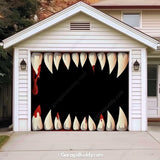
Do check our DIY garage door cover for HALLOWEEN
3. How much does garage door repair cost?
Repair costs vary significantly by what's broken:
- Spring replacement: $150–$350 (the most common repair)
- Cable replacement: $100–$200
- Panel replacement: $150–$400 per panel
- Opener repair: $100–$300
- Track realignment: $75–$150
- Roller/hinge replacement: $50–$120
Most service calls include a diagnostic fee of $50–$100, which is often applied toward the cost of the repair if you proceed.
4. How much does a garage door opener cost?
A standard chain-drive opener runs $150–$250. Belt-drive (quieter) models cost $200–$350. Smart openers with Wi-Fi and app control range from $250–$500. Add $100–$150 for professional installation if you prefer not to DIY. Wall-mount (jackshaft) openers for high-lift doors start around $350.
5. What should I spend on a quality garage door?
For most homes, spending $800–$1,500 installed gets you a durable, insulated steel door that will last 20–30 years. Going cheaper often means thinner steel (25-gauge vs. the better 24-gauge) and no insulation. Going higher buys aesthetics — wood-look finishes, custom colours — rather than just extra longevity. Garage door replacement consistently ranks among the highest ROI home improvements, often returning 90%+ at resale.
6. How much does garage door spring replacement cost?
Spring replacement costs $150–$350 and is the single most common garage door repair. Always replace both springs at the same time — if one has broken, the other is equally worn. High-cycle springs (rated for 25,000–50,000 cycles) cost more upfront but last significantly longer. This repair should always be carried out by a professional due to the extreme tension stored in the springs.
| Our most loved garage door cover in USA! |
Installation
7. Can Home Depot install my garage door?
Yes. Home Depot offers garage door installation through their network of independent contractors. You purchase the door in-store or online, and a local installer is scheduled. It's convenient, but you're limited to Home Depot's product selection. The quality of installation depends on the local contractor assigned — always ask for their licence and insurance before work begins.
8. DIY vs. professional garage door installation — which should I choose?
DIY installation can save $200–$500 in labour, but garage door springs are under extreme tension and can cause serious injury if mishandled. If you're mechanically confident and installing a lighter door, DIY is feasible. For heavy doors, double-car doors, or torsion spring systems, hire a professional. The labour cost is well worth the safety guarantee and warranty that typically comes with professional installation.
⚠️ Safety warning: Never attempt to adjust or replace torsion springs without proper training. The stored energy is capable of causing fatal injuries.
9. What is included in a professional garage door installation?
A standard professional installation typically includes: removal and disposal of the old door, assembly and hanging of the new door panels, installation of tracks, rollers, hinges, and springs, opener mounting and programming, safety sensor alignment, and a final balance test. It generally does not include painting, drywall patching, or new electrical work. Ask for an itemised quote before work starts.
10. How long does garage door installation take?
A straightforward single-car door swap takes 3–5 hours for a professional crew. A double-car door or one with custom framing modifications can take 6–8 hours. If a new opener is included, add 1–2 hours. Most installations are completed in a single day.
11. Do I need permits for garage door installation?
A straight replacement (same-size door, no structural changes) usually doesn't require a permit. However, if you're widening the opening, changing the header height, or converting a carport, permits are almost always required. Check with your local building department. A reputable installer will know local rules and can pull permits on your behalf. Skipping a required permit can complicate future home sales.
12. What is the best time of year to replace a garage door?
Spring and autumn are ideal — mild temperatures make installation easier and you won't lose a day of heating or cooling. Late winter (February–March) sees lower demand, so you may get quicker scheduling and slightly better pricing. In warmer climates, the time of year matters far less.
Do check our DIY garage door cover for HALLOWEEN
13. How do I find a reliable garage door company?
Look for: a physical business address; licence and insurance verification; membership in the IDA (International Door Association); genuine Google reviews with photos; and clear written quotes before work begins. Be cautious of companies that only quote over the phone, pressure you to decide immediately, or arrive in unmarked vehicles. For major installations, get 2–3 quotes.
Repairs & Troubleshooting
14. Why is my garage door not opening?
The most common causes:
- Dead remote batteries — try the wall button first to rule this out
- Tripped disconnect switch — look for a dangling red cord near the opener
- Broken torsion spring — often preceded by a loud bang; the door will feel extremely heavy
- Misaligned safety sensors — both LED lights should be solid, not blinking
- Power outage — check the outlet the opener is plugged into
- Blocked or bent tracks
If a broken spring is the cause, do not try to force the door open manually. Call a professional.
15. My garage door won't close — what should I do?
A door that opens fine but won't close is almost always a sensor issue. Check that nothing is blocking the beam between the two sensors at the bottom of the tracks. Wipe the sensor lenses — dust and spider webs are very common culprits. Both LED indicator lights should be solid (not blinking). If sensors are fine, the down-limit setting on your opener may need adjustment. If the door reverses immediately after touching the ground, the down-force or close-limit needs recalibrating.
16. Why is my garage door making strange noises?
- Squeaking/grinding: Dry rollers, hinges, or springs — lubricate with a white lithium-based spray
- Rattling: Loose hardware — tighten all track bolts and panel hinges
- Banging: Often a broken spring or unbalanced door — call a professional
- Popping/creaking: Metal expanding and contracting with temperature changes — usually harmless
- Scraping: Door or rollers rubbing against the track — check for bent sections
Annual lubrication prevents the vast majority of noise issues.
17. Can I replace just one garage door panel?
Yes, provided the door is relatively new and the replacement panel is still available from the manufacturer. Panel replacement makes sense when damage is limited to one section, the door is less than 10–12 years old, and other panels are structurally sound. If the door is older or discontinued, a full replacement is usually more cost-effective. A panel typically costs $150–$400 plus labour.
18. How do I tell if my garage door is out of balance?
The manual balance test: disconnect the opener by pulling the red emergency cord, then manually lift the door to about waist height and let go. A balanced door will stay in place. If it drops quickly or shoots upward, the spring tension is off. An unbalanced door puts excessive strain on the opener motor and will shorten its lifespan. Have a technician adjust the spring tension — this is not a safe DIY task.
19. What are the signs my garage door needs repair or replacement?
Repair signs: Squeaking or grinding noises, slow movement, door doesn't fully open or close, sagging in one corner, visible rust on springs or cables.
Replace signs: Severe panel damage from impact, door is 20+ years old with recurring problems, rising energy bills from poor insulation, or repair costs approaching 50% of a new door's price. The "50% rule" is a useful guideline — if a single repair exceeds half the cost of a new door, replace it.
20. When should I call an emergency garage door repair service?
Call immediately if: a spring has snapped, a cable is frayed or broken, the door has come off its tracks, or the door is stuck open and you cannot secure your home. Most garage door companies offer 24/7 emergency services for these situations. Do not try to force a door that's off its tracks — you risk further damage and potential injury.
21. How do I replace a broken garage door cable?
Cables work in tandem with springs to support the door's weight. When a cable snaps, the door can drop asymmetrically. While technically possible to DIY, it requires releasing spring tension first — which is hazardous without experience. Professional replacement costs $100–$200 and takes about an hour. Always replace both cables simultaneously as they wear at the same rate.
22. Quick fixes for common garage door problems
- Remote not working: Replace batteries first, then reprogram
- Door reverses mid-close: Clean and realign the safety sensors
- Squeaking: Spray white lithium grease on rollers, hinges, and springs (not the tracks)
- Keypad not responding: Replace batteries or reset the entry code
- Slow movement: Lubricate all moving parts; check opener force settings
- Door sags in the middle: Tighten the tension rods on the back of the door
Maintenance
23. How often should I service my garage door?
A professional inspection every 1–2 years is the ideal frequency. For your own maintenance routine: lubricate all moving parts each spring and autumn, visually inspect cables and springs for fraying or rust, test the auto-reverse feature monthly (place a flat 2x4 on the ground — the door should reverse on contact), and tighten any loose hardware. A proactive $100 tune-up can prevent a $400 repair down the line.
24. How do I maintain my garage door in winter?
Cold weather is hard on garage doors. Before winter arrives: lubricate all metal parts (cold thickens grease and strains motors), inspect weatherstripping and replace it if cracked, check that the door seals flush with the floor, and test the opener. After a heavy freeze: never force a door that's stuck to an icy floor — thaw it gently. Keep de-icer away from the bottom rubber seal, as it can cause cracking over time.
25. How do I weather-seal my garage door?
There are four key sealing points: the bottom seal (rubber strip that contacts the floor), the side seals (vertical weatherstripping on each side of the frame), the top seal (horizontal strip above the door), and inter-panel seals where applicable. Replace the bottom seal every 2–3 years or when it shows cracking. Good weather-sealing reduces drafts, lowers energy bills, keeps out rodents, and protects stored items from moisture. Most replacements are DIY-friendly and cost $30–$80 in materials.
26. What causes garage door damage and how can I prevent it?
- Impact damage: Cars and sports equipment — install foam bumpers and wall-mounted storage to protect panels
- Rust and corrosion: Touch up bare metal spots annually with rust-inhibiting primer and paint
- UV fading: Apply a UV-resistant sealant on wood and painted steel doors every 2–3 years
- Moisture damage: Ensure proper drainage at the base; seal any gaps around the frame
- Mechanical wear: Regular lubrication and annual inspections are your best defense
27. How long do garage doors typically last?
A well-maintained steel garage door lasts 20–30 years. Wood doors can last equally long but require more upkeep (painting, sealing). Vinyl and fiberglass doors last 20–25 years. Openers typically last 10–15 years. Springs are the shortest-lived component — standard springs last 7–10 years, while high-cycle springs can last 15–20 years. Regular maintenance is the single biggest factor in maximizing door lifespan.
Types, Materials & Design
28. What are the different types of garage doors?
By operating style:
- Sectional: The most common type in North America — horizontal panels that roll up overhead along tracks. Reliable and space-efficient.
- Roll-up: Coils into a drum above the opening. Common in commercial or tight-clearance applications.
- Swing-out (carriage style): Hinged doors that swing outward. Modern versions typically still run on a track.
- Tilt-up canopy: A single solid panel that tilts upward and outward. Less common and a simpler mechanism.
- Side-hinged: Traditional barn-door style. Rare for residential use.
29. Sectional vs. rolling garage doors — how do they compare?
Sectional doors are the better choice for most homes — they're quiet, well-insulated, safe (nothing swings outward into the driveway), and work with virtually all openers. Rolling doors excel in commercial settings or where ceiling clearance is very limited. Rolling doors are harder to insulate effectively and are generally noisier. For a residential garage, sectional wins on almost every metric.
30. What are the best garage door brands?
The most consistently well-regarded brands are Clopay (widest range, excellent build quality), Wayne Dalton (innovative designs, strong insulation options), Amarr (solid value), and Raynor (commercial-grade residential options). For openers, LiftMaster/Chamberlain lead the market for reliability; Genie is a strong alternative. Avoid unknown off-brand doors unless you can verify that replacement parts will be available for future repairs.
31. What is the best insulation for a garage door?
Insulation is rated by R-value — higher means better thermal performance:
- Polystyrene panels (R-6 to R-9): Budget-friendly, lightweight, glued into door sections
- Polyurethane foam (R-12 to R-18): Injected between steel skins — more rigid, higher R-value, better sound dampening
For an attached garage (where the door is effectively a wall of your living space), aim for R-12 or higher. For a detached garage used for storage only, R-6 is sufficient. Insulated doors also noticeably reduce street noise.
32. Can I paint or refinish my garage door?
Yes. Steel doors can be painted with any exterior-grade latex paint — clean thoroughly, apply a rust-inhibiting primer, then two finish coats. Wood doors accept paint or stain. Fiberglass takes paint well. Vinyl can be painted, though the finish may not bond as permanently. A fresh coat of paint in a bold colour is one of the highest-ROI curb appeal upgrades you can make. Plan to repaint every 5–7 years or when peeling or fading becomes noticeable.
33. What about glass panel garage doors?
Full-view aluminium doors with glass panels are increasingly popular for modern and contemporary homes. Pros: excellent natural light, striking curb appeal, and a range of glass options (frosted, tinted, clear). Cons: lower insulation (unless thermally broken frames with dual-pane glass are specified), reduced privacy with clear glass, and higher cost ($1,500–$4,000+). Always specify tempered safety glass — it is required by most building codes.
Safety
34. Garage door safety: what every homeowner needs to know
- Test the auto-reverse feature monthly — place a flat 2x4 on the ground; the door should reverse on contact
- Keep remote controls out of children's reach and treat them like car keys
- Never leave the door partially open — it can be forced upward from outside
- Install a deadbolt on any interior door connecting your garage to your home
- Never run a car engine in an attached garage — carbon monoxide poisoning risk
- Keep fingers clear of panel joints during manual operation
- Never walk under a moving door or allow children to play near it
35. Safety concerns for children and pets
Garage doors are among the largest moving objects in any home. Keep children and pets clear of the door's path while it is in motion. Teach children never to run under a closing door. Disable the close button on low-mounted wall controls if small children are present. Confirm photo-eye sensors are at the correct height (no more than six inches above the floor) and test them monthly. Many modern openers also feature motion-detection lights or integrated cameras.
36. How do I get my garage door professionally inspected?
Most garage door companies offer inspection and tune-up services for $75–$150. A comprehensive inspection covers: spring tension and condition, cable integrity, roller and hinge wear, track alignment, weatherstripping, opener force and limit settings, auto-reverse test, and lubrication of all moving parts. Schedule one every 1–2 years, or before winter in cold climates.
| Checkout our Christmas and Holidays garage door collection. |
Tech & Smart Upgrades
37. Is a smart garage door opener worth it?
For most people, yes. Smart openers let you open and close the door remotely via smartphone, receive alerts if the door is left open, and integrate with smart home platforms like Alexa, Google Home, and Apple HomeKit. The convenience and security alone justify the $50–$150 premium over a standard opener. Top picks include the Chamberlain myQ series and the Meross smart garage controller (a retrofit option for existing openers).
38. What are my noise reduction options?
In order of impact: (1) Switch from a chain-drive to a belt-drive opener — the single biggest improvement; (2) Replace steel rollers with nylon ones; (3) Lubricate all hinges, springs, and rollers with white lithium grease; (4) Install anti-vibration pads on the opener mounting bracket; (5) Add door insulation, which absorbs some sound transmission. A noisy door is often just a maintenance issue — try lubrication first before buying anything.
39. Garage door insulation: what are my options for an existing door?
Retrofit insulation kits cost $50–$200 in materials and are DIY-friendly. Benefits include lower heating and cooling bills in attached garages, reduced noise, a more comfortable workspace, and added rigidity to the door panels. That said, if your door is older, a new insulated door will outperform a retrofit kit in the long run. Retrofit kits also add weight — confirm your opener and springs can handle the extra load before installing.
40. Will a new opener be compatible with my existing remotes and keypads?
Most modern openers use rolling-code security protocols compatible with current remotes and keypads. When upgrading, check: (1) Whether your existing remotes will work or need replacing; (2) Whether the new opener requires a hub (such as myQ) or connects directly to Wi-Fi; (3) Whether the opener's horsepower suits your door's weight — a 1/2 HP motor handles most residential doors, while heavy wood doors may need 3/4 HP.
Permits, Warranties & Finding a Pro
41. What does a garage door warranty typically cover?
Most reputable brands offer: a lifetime warranty on door panels against manufacturing defects and rust perforation; 1–5 years on springs; 1–3 years on the opener (motor and electronics); and 1 year on installation labour. Most warranties are voided by improper installation, neglected maintenance, or physical damage. Keep your invoice and installation records for any future claims.
42. Commercial vs. residential garage doors — what is the difference?
Commercial doors are built for high-cycle use (springs rated for 100,000+ cycles), heavier-gauge steel, larger dimensions, and often must meet fire or wind-load codes. Residential doors are engineered for 8–15 cycles per day, standard dimensions, and place a premium on aesthetics and insulation. Using a commercial door in a home is generally overkill and unnecessarily expensive; using a residential door in a commercial setting will lead to premature failure.
43. What about garage door aesthetics and curb appeal?
Your garage door can occupy 30–40% of your home's visible front facade. Design tips: match the door's style to your home's architecture; consider carriage-house hardware for a classic look without a full door swap; choose a colour that complements or deliberately contrasts your trim; and adding windows in the top panels brightens the interior and improves street presence. A new garage door ranks consistently among the top three ROI home improvements at resale.
44. How do I handle an emergency lockout situation?
If your remote fails and you're locked out: try the exterior keypad if you have one; check for a keyed lock cylinder on the door; look for a side door into the garage. As a preventative measure, store a backup remote in your car, maintain a keypad entry code, and save a 24-hour garage door service number in your phone. If completely locked out, call an emergency garage door technician — don't attempt to force the door off its tracks.
45. Can I customise the design of my garage door?
Absolutely. Most major manufacturers offer custom colour matching, window insert configurations, decorative hardware (hinges, handles), woodgrain embossed finishes, and custom panel widths or heights. Custom doors typically add $300–$1,000+ to the price depending on complexity. If you're replacing a door primarily for aesthetic reasons, it's worth spending time with a manufacturer's online visualiser tool to see how different styles look on your home's exterior before committing.
Still have questions about your garage door?
Every garage door situation is a little different. When in doubt, book a professional inspection — most service calls are affordable and give you a clear picture of what's needed before any money is spent on repairs.